Online Casinos California 2026 — Legal Gaming Options for CA Players
This guide maps every legal online gaming option available to California residents in 2026 — covering AB 831, which platforms exited, what’s still legal, and what the legislative horizon actually looks like. Every operator status and law reference verified May 2026.
Casino32bit mapped every legal online gaming option available to California residents in 2026 — and the picture is less promising than most players hoping to find a sweepstakes alternative want to hear. As of January 1, 2026, California banned dual-currency sweepstakes casinos under Assembly Bill 831. Every major platform exited the state. Regulated real-money online casinos remain illegal under California’s constitution. This guide explains exactly where things stand, what you can legally do, and what the path forward looks like. For the full picture of what’s available in other states, visit the online casinos USA guide.










Is online gambling legal in California in 2026? ⚖️
Regulated real-money online casinos: illegal — constitutional barrier, no regulatory pathway
Online sports betting: illegal — Proposition 27 failed 83–17% in November 2022
Dual-currency sweepstakes casinos: banned by AB 831 effective January 1, 2026
Daily Fantasy Sports (DraftKings / FanDuel): legal statewide
Free social casinos (no prizes): legal statewide
Card Crush (single-currency model): operating but legal status untested
Proposition 27 failure and California’s current gambling law explained
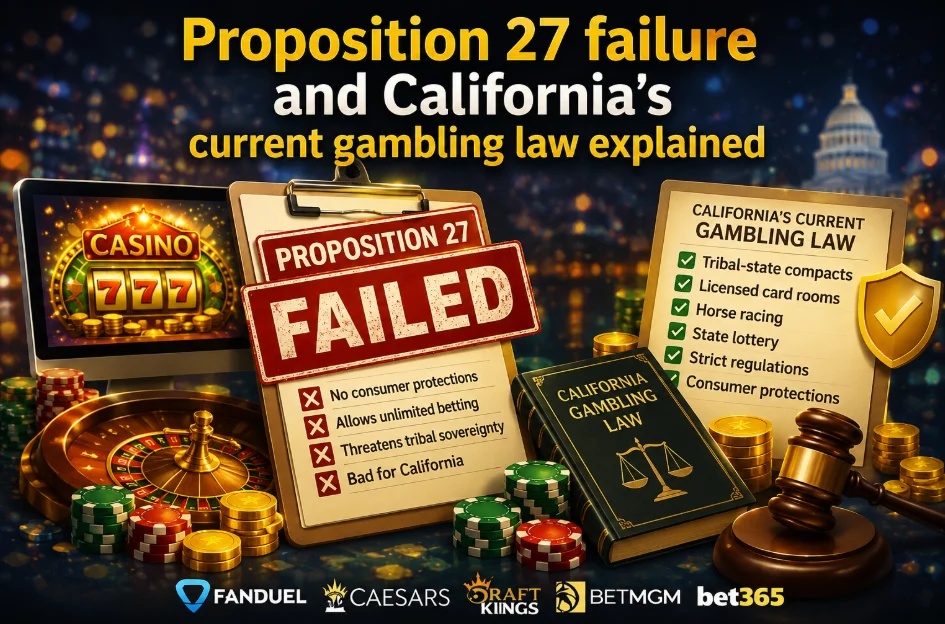 In November 2022, California voters rejected both Proposition 26 (in-person sports betting at tribal casinos and horse-racing tracks) and Proposition 27 (online and mobile sports betting through tribal-state compacts). Proposition 27 failed 83% to 17% — a landslide rejection. The California Constitution reserves casino-style gambling for tribal nations, and California tribes spent heavily to defeat both measures, viewing them as threats to their exclusive gaming compact rights. This constitutional provision, combined with the political weight of tribal gaming interests, creates a structural barrier to online casino legalization that doesn’t exist in states like New Jersey or Pennsylvania — where the legislature simply passed enabling legislation.
Why regulated real-money online casinos remain illegal in California
California’s constitution limits casino-style gambling to tribal entities, with limited exceptions for card rooms and horse racing. There is no regulatory pathway for a company like BetMGM, DraftKings, or FanDuel to obtain a California online casino license under current law. The California Gambling Control Commission does not have authority to license online casino operators outside the tribal compact structure. Even if the legislature passed a bill tomorrow, it would face legal challenge from tribes, card rooms, or both. The realistic assessment: regulated online casino access for California players is not coming in 2026, and concrete progress in 2027 looks doubtful without a significant political realignment. For a state-by-state comparison, visit the sweepstakes casinos by state guide.
What California players can legally do online right now ✅
Before AB 831 — which sweepstakes casinos were available in CA
Through December 31, 2025, California residents had access to the same sweepstakes casinos available in most US states: McLuck, Pulsz, Stake.us, WOW Vegas, Crown Coins, Chumba Casino, High 5 Casino, and dozens of smaller platforms. California was one of their largest markets — 39 million residents with no regulated real-money alternatives. That access ended January 1, 2026.
California Assembly Bill 831 — what it banned, when it took effect
Governor Gavin Newsom signed AB 831 on October 11, 2025. The bill passed the California Senate 36–0 and the Assembly 63–0 — a unanimous sweep that left zero ambiguity about legislative intent. AB 831 made it unlawful to operate, conduct, or offer an online sweepstakes game in California. Critically, the law extended misdemeanor liability beyond platform operators — payment processors, geolocation providers, gaming content suppliers, and media affiliates that “knowingly and willfully” support sweepstakes casino operations in California also face penalties of $1,000–$25,000 per violation plus potential jail time. This liability extension made it commercially unviable for any major operator to remain. The platforms didn’t just face platform-level liability — their entire service ecosystem faced it.
AB 831 — the sweepstakes ban that reshaped California gaming 🏛️

Which operators exited California — McLuck, Pulsz, Crown Coins status
Card Crush launched December 29, 2025 using a single-currency model (Mystery Coins) to sit outside AB 831’s dual-currency definition. McLuck emailed its California players promoting Card Crush as an alternative in January 2026. Important: its legal status is not settled or tested law — California regulators retain authority to challenge its model. Casino32bit notes its existence but does not recommend it as a definitive legal solution.
Legal online gaming options for California residents in 2026 🎮
Daily fantasy sports — FanDuel and DraftKings legal access in California
DraftKings and FanDuel both operate legally in California for Daily Fantasy Sports. California classifies DFS as a game of skill, not gambling. DFS involves building contest lineups from real athletes and competing for cash prizes based on statistical performance — you’re competing against other players’ lineups, not a house edge. DraftKings also launched Superstars (peer-to-peer platform) in California on January 1, 2026. If you want any form of online gaming with real cash prizes in California right now, DFS is the clearest legal path. If you want to explore casino games in states where they’re legal, they require traveling to a regulated state.
Tribal casino apps and card room platforms available to CA residents
 California has over 70 tribal land-based casinos offering real-money gaming — blackjack, slots, poker, and table games. Several tribal operators have digital apps or platforms, but these require the player to be physically present on tribal land for real-money play. Remote casino gambling via tribal apps is not licensed or available in California. Card rooms — including Commerce Casino and Bicycle Hotel & Casino, some of the largest in the country — operate legally under state law but only in-person.
Sports betting in California — current legal status and tribal operations
Online sports betting is not legal in California. Proposition 27 was rejected 83% to 17% in November 2022. Proposition 26, which would have allowed in-person sports betting at tribal properties and horse-racing tracks, also failed. As of May 2026, no serious legislative or ballot initiative effort to legalize online sports betting in California is in active progress.
California gambling legislation in progress 📋
Conservative estimate: not before 2028 at the earliest, requiring a ballot initiative, tribal consensus, and voter approval — all uncertain. No bill currently before the California legislature would establish a regulated online casino market. No ballot initiative signature gathering is underway for the 2026 election cycle. The more realistic view from gambling industry analysts is 2028–2030 at best. California players who want regulated real-money online casino access near term have one practical option: travel to a regulated state (Nevada for poker, or New Jersey / Pennsylvania / Michigan / West Virginia / Connecticut for full online casino access).
Tribal vs card room interests — what each side wants from future law
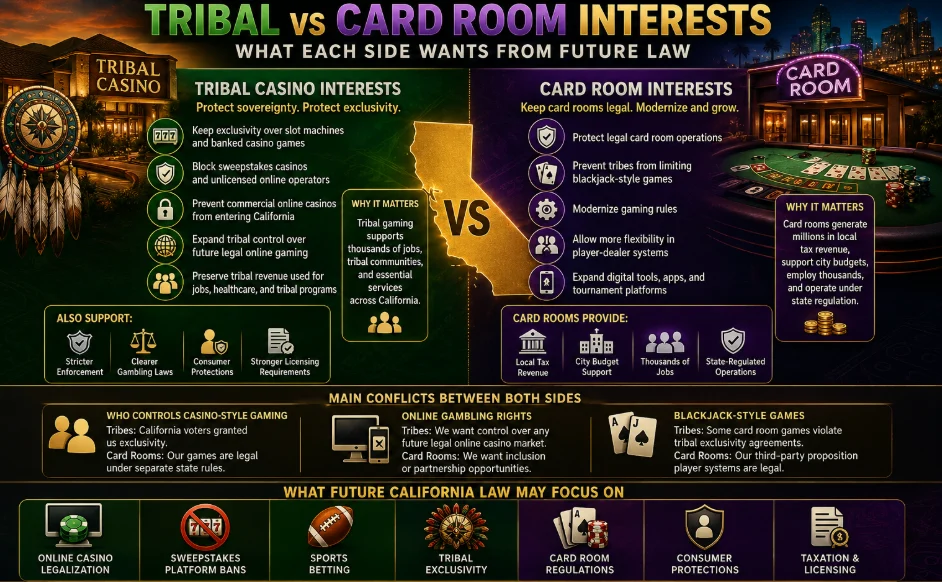 California’s tribes hold exclusive rights to casino-style gambling under compact agreements with the state. They’ve consistently opposed online gambling expansion that would give non-tribal entities — particularly card rooms and tech companies — access to the online casino market. The Yuhaaviatam of San Manuel Nation was the primary backer of AB 831, which banned sweepstakes casinos — widely understood as tribal protection of physical casino revenue from online competition. Card rooms want a seat at the online table that tribes don’t want to give them. This fundamental conflict has blocked gambling expansion in California for years and shows no sign of resolving soon. Players seeking casino bonuses of the type available in regulated states should understand this is not a near-term prospect in California.
Timeline estimates for regulated online casino access in California
No bill currently before the California legislature would establish a regulated online casino market. No ballot initiative signature gathering is underway for the 2026 election cycle. Two gambling expansion attempts via ballot measure (Propositions 26 and 27) both failed in 2022 by wide margins. The realistic timeline from gambling industry analysts: California online casino legalization is a 2028–2030 conversation at best, contingent on a change in tribal strategy on the online question.
Offshore casinos and California — risks US players face ⚠️
Offshore casinos provide no regulatory protection, no player fund guarantees, and no dispute resolution pathway. If an offshore casino refuses a withdrawal or closes, there is no state gaming commission or legal mechanism to recover funds. Using a VPN to access banned platforms does not provide legal protection under California law — it doesn’t change your legal status under AB 831 or federal statutes. The consumer protection argument alone is sufficient reason to avoid offshore casinos, without even reaching the legal question.
Responsible gambling resources for California players 🛡️
California’s tribal casinos operate under federally recognized tribal sovereignty — there is no statewide self-exclusion program equivalent to the ones in New Jersey or Pennsylvania. Self-exclusion from tribal casinos is handled individually by each tribe. Contact that casino’s gaming commission, HR department, or cage supervisor directly. Some tribes participate in voluntary exclusion programs covering multiple properties within their network. For a broader overview of responsible gambling tools at licensed online casinos in other states, visit the responsible gambling guide.
FAQ — Online Casinos California ❓
⚖️ Is online gambling legal in California in 2026?
No. Regulated real-money online casinos are not legal in California under current state law. The California Constitution limits casino-style gambling to tribal entities. No legislative pathway currently exists to license non-tribal online casino operators. Online sports betting is also not legal following the failure of Proposition 27 in 2022. Sweepstakes casinos were banned by AB 831 effective January 1, 2026.
🎰 Can I play sweepstakes casinos in California after AB 831?
No — not at the platforms that existed before January 1, 2026. AB 831 banned dual-currency sweepstakes platforms (Gold Coins + redeemable Sweeps Coins) in California. McLuck, Pulsz, Stake.us, WOW Vegas, Crown Coins, and Chumba Casino all exited the state. Card Crush launched as a single-currency alternative, but its legal status under AB 831 is untested. Free social casinos with no prizes remain fully legal.
🎮 What online gaming is legal for California residents right now?
Daily Fantasy Sports through DraftKings and FanDuel is legal and available statewide. Free social casinos (no prizes, no redemption) are legal. Tribal casino apps require physical presence on tribal land. Everything else — regulated online casinos, online sports betting, and dual-currency sweepstakes platforms — is either prohibited by law or constitutionally unavailable in California in 2026.
📋 When will regulated online casinos be available in California?
No reliable timeline exists. The most optimistic industry estimates point to 2028–2030, contingent on tribal consensus supporting online casino access and a successful ballot initiative or constitutional amendment. No active bill or ballot initiative is in progress as of May 2026. Two gambling expansion attempts via ballot measure (Propositions 26 and 27) both failed in 2022 by wide margins.
⚠️ Are offshore online casinos safe for California players?
No. Offshore casinos operating without a California or US state license provide no regulatory protection, no player fund guarantees, and no dispute resolution pathway. If an offshore casino refuses a withdrawal or closes unexpectedly, there is no state gaming commission or legal mechanism to recover funds. Casino32bit does not recommend offshore casinos to California players under any circumstances. Using a VPN to access banned platforms does not provide legal protection under California law.